Commercial French Fries Production Solution for Central Kitchens and Food Brands
What Is a Small-Scale Commercial French Fries Production Line?
A small-scale commercial French fries production line is a compact, semi-automated or fully automated processing system that transforms raw potatoes into frozen or ready-to-cook French fries at outputs ranging from 100 kg/h to 300 kg/h. Designed specifically for central kitchens, emerging food brands, and regional distributors, this solution integrates washing, peeling, cutting, blanching, de-watering, frying (or par-frying), de-oiling, and freezing into one streamlined, hygienic workflow. It delivers consistent fry quality, reduces labor costs by up to 70%, and requires 50–70% less floor space and capital investment than large-scale industrial plants—making it the ideal entry point for businesses scaling from manual production to standardized, high-margin French fry manufacturing.
The Core Problem We Solve
Most small and medium food enterprises face three critical bottlenecks when producing French fries:
- Inconsistent Quality — Manual cutting and frying create uneven sizes, color variation, and unstable texture that fail retail and foodservice standards.
- High Labor & Waste Costs — Hand peeling and sorting waste 15–20% of raw material and demand significant manpower.
- Limited Scalability — Kitchen equipment cannot meet rising order volumes without sacrificing hygiene or food safety compliance.
Our small-scale production solution eliminates these pain points through standardized automation, precision cutting, and controlled frying technology—ensuring every batch meets commercial-grade specifications.
Small French Fries Production Line Specifications at a Glance

Semi-Automatic French Fries Production Line Output 300kg/h
Output Capacity: 100 – 300 kg/h (customizable)
Product options: Fresh-cut fries, par-fried fries, frozen fries
Potato Yield Rate: Up to 92% utilization
Automation Level: Semi-auto / Fully-auto configurations
Power Supply: 220V/380V, 50/60Hz (region-adaptable)
Heating Options: Electric, Gas
Material: SUS304 / SUS316 Food-Grade Stainless Steel
Compliance: CE, ISO 9001, HACCP-ready design
Core equipment: Washer-peeler, cutter, batch blancher, centrifugal dewaterer, batch fryer, deoiler
Optional equipment: Quick freezer, cold storage, weighing and semi-automatic packaging
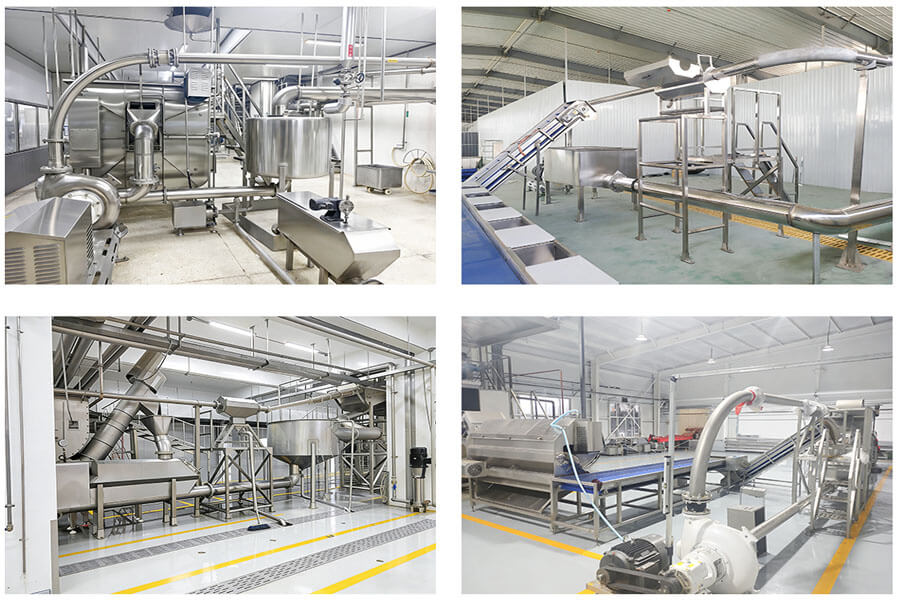
Layout: Modular arrangement adapted to site dimensions and workflow
Intended users: Central kitchens, restaurant chains, food brands, regional processors
CONTACT US FOR A FREE CONSULTATION
Who Is This Solution For?
This production setup suits businesses that need reliable commercial output but do not require a continuous high-volume factory line.
- Central kitchens supplying restaurants, hotels, schools, or institutional food services.
- Restaurant and café groups seeking consistent fries across multiple locations.
- Food brands producing private-label or branded fresh and frozen potato products.
- Regional distributors supplying food-service customers with prepared fries.
- Agricultural processors adding value to locally grown potatoes.
The modular configuration can also support product development. Operators can trial different cut sizes, blanching conditions, frying profiles, and pack formats without redesigning a continuous production line.

Semi-Automatic French Fries Production Line Output 300kg/h
How the Production Line Works: Step-by-Step Process Flow
A small-scale commercial line generally uses batch equipment for blanching, dewatering, frying, and deoiling. Operators transfer product between stations using baskets, bins, or short conveyors, depending on the required level of automation.
Semi-Automatic Frozen French Fries Production Line
Complete Potato Chips & French Fries Plant Solutions
1. Potato Washing and Peeling
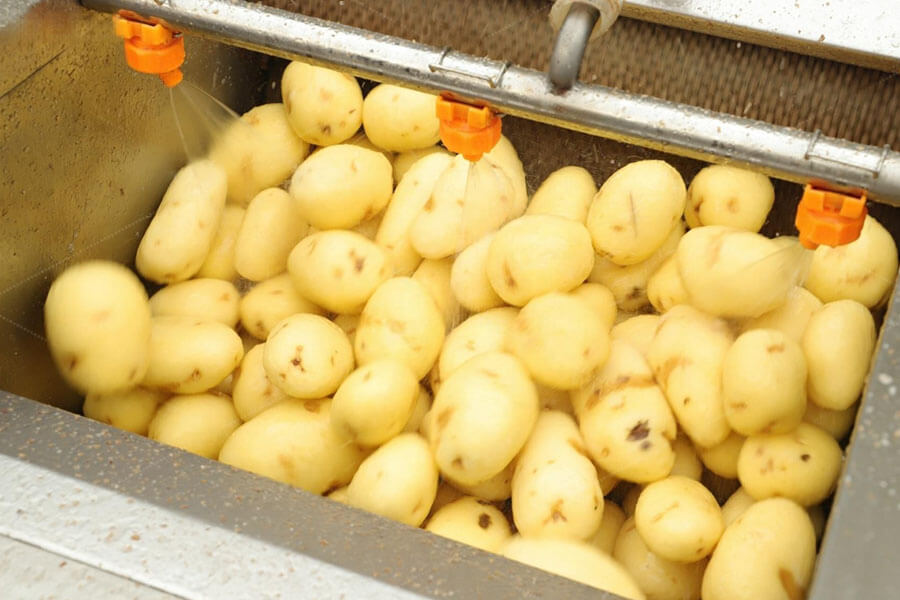
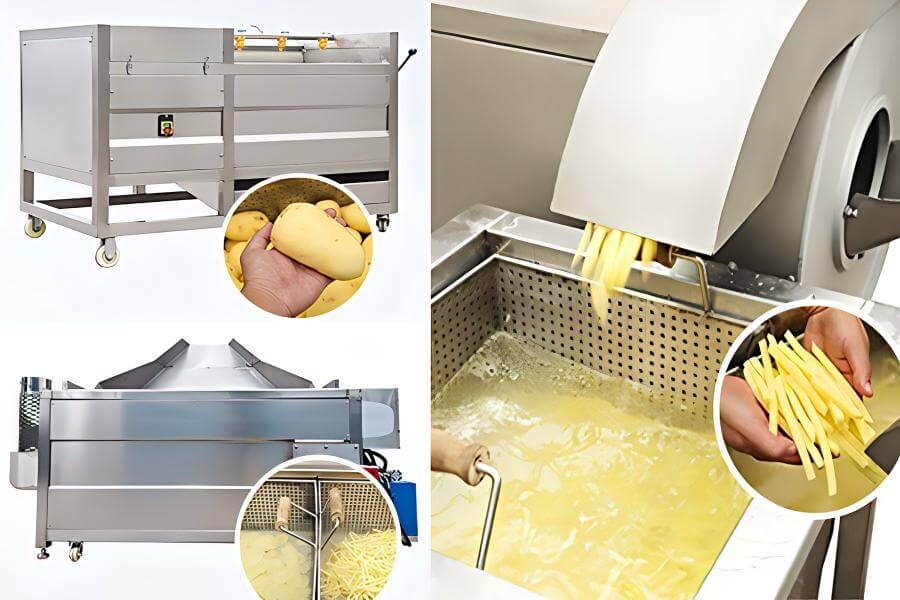
A washer removes soil and loose debris from incoming potatoes. A brush or abrasive peeler removes the skin; the appropriate peeling method depends on potato condition, required yield, and product quality targets. A sorting table can be added to remove defective potatoes before cutting.
2. French Fries Cutting
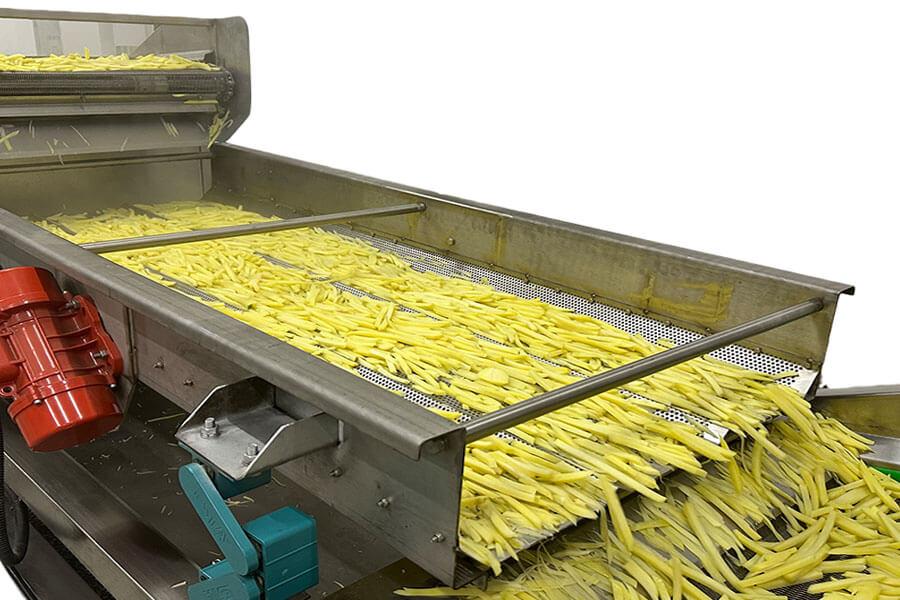
A commercial cutter slices potatoes into uniform strips. Common cut sizes include 7 × 7 mm, 9 × 9 mm, and 12 × 12 mm, with other sizes and specialty cuts available by configuration. Consistent dimensions help fries cook evenly and produce a predictable finished appearance.
3. Rinsing and Batch Blanching
Cut potatoes are rinsed to remove loose surface starch. They can then be blanched in a batch blancher using a process selected for the potato variety and desired product. Blanching can help manage color and texture, but the time and temperature should be established through product trials rather than treated as a universal setting.
4. Centrifugal Dewatering
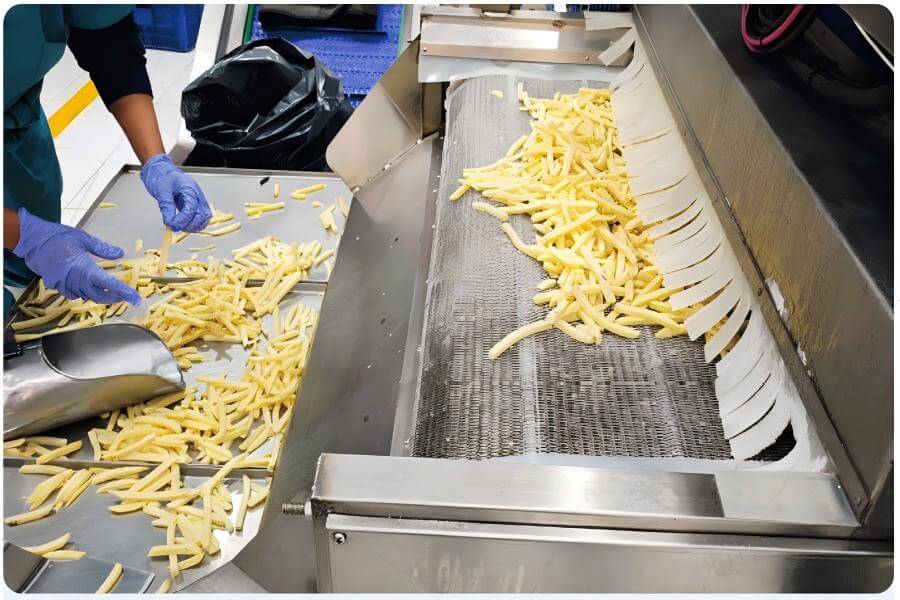
After blanching and draining, fries are loaded into a centrifugal dewatering machine. Spinning removes surface water before frying, helping reduce splashing and support consistent frying. The operating speed and cycle time should be matched to fry size and product firmness.

5. Batch Frying
A batch fryer cooks fries to the required specification. For par-fried frozen products, the process is different from producing ready-to-eat fries: the fry time, oil temperature, and target moisture must be determined in line with the recipe and downstream cooking method. Electric, gas, or other heating options may be available depending on the machine design and local utilities.
6. Centrifugal Deoiling and Cooling
Following frying, a centrifugal deoiler removes excess surface oil. Fries are then cooled using a suitable hygienic cooling arrangement before packing or freezing. Cooling time and handling should be designed to avoid unnecessary product dwell time and maintain food-safety controls.
7. Optional Quick Freezing
For frozen fries, cooled product can be transferred to a batch quick freezer or a suitably sized IQF system. The freezer must be selected according to the required throughput, product loading, freezing time, available cold-room capacity, and target core temperature. Freezing equipment is a key capacity constraint: its rated capacity should match the actual production rate of the upstream line.
8. Weighing and Semi-Automatic Packaging
A semi-automatic packaging station can include a platform scale or electronic weigher, bag holder, heat sealer, and date or batch coder. This setup suits businesses using multiple bag sizes or moderate production volumes. Frozen products require packaging materials and seals suitable for frozen storage and distribution.
9. Customization Options
Every business is different. We tailor your production line based on:
- Target output volume and shift schedule
- Available factory space and layout constraints
- Energy source (electric, gas, thermal oil)
- Product mix (straight-cut, crinkle, shoestring, hash browns)
- Automation level and budget
- Local voltage and compliance requirements
Key Benefits & Competitive Advantages
A small-scale French fries line enables food brands to capture higher margins by producing in-house instead of reselling third-party products. With labor reductions of up to 70%, raw material savings from improved yield, and premium pricing on branded frozen fries, most operators achieve payback within 12–24 months, depending on utilization and market pricing.
✅ Lower Capital Investment — Up to 60% less than full industrial lines, delivering faster ROI
✅ Compact Footprint — Fits within existing central kitchen or small factory spaces
✅ Modular & Scalable — Add modules as your volume grows; upgrade from semi-auto to fully-auto
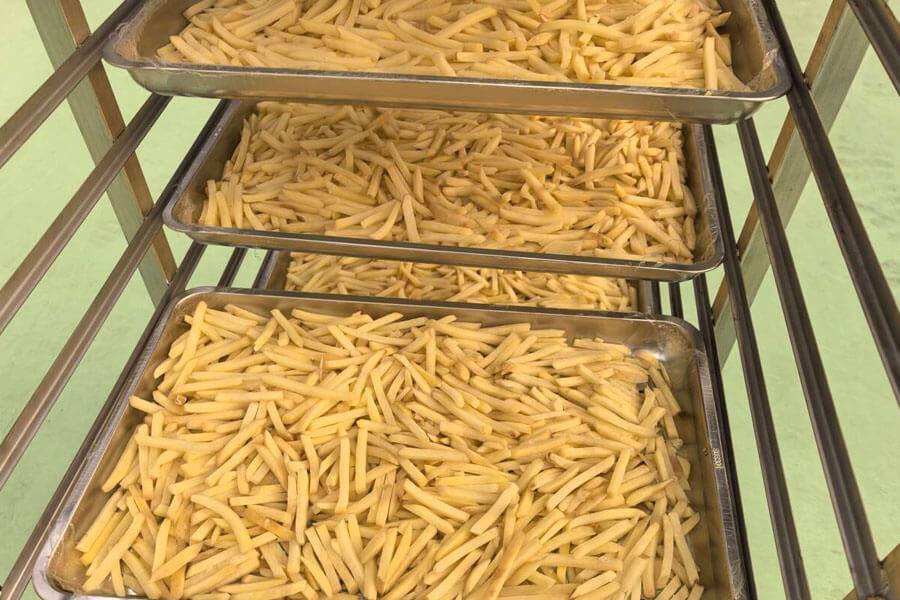
✅ Consistent Commercial Quality — Uniform size, color, and crispness in every batch
✅ Food Safety Compliant — HACCP-ready, SUS304/316 construction, easy-clean design
✅ Energy Efficient — Heat-recovery options and insulated fryers reduce operating costs
✅ Flexible Product Range — Produce multiple fry styles and expand into other potato snacks