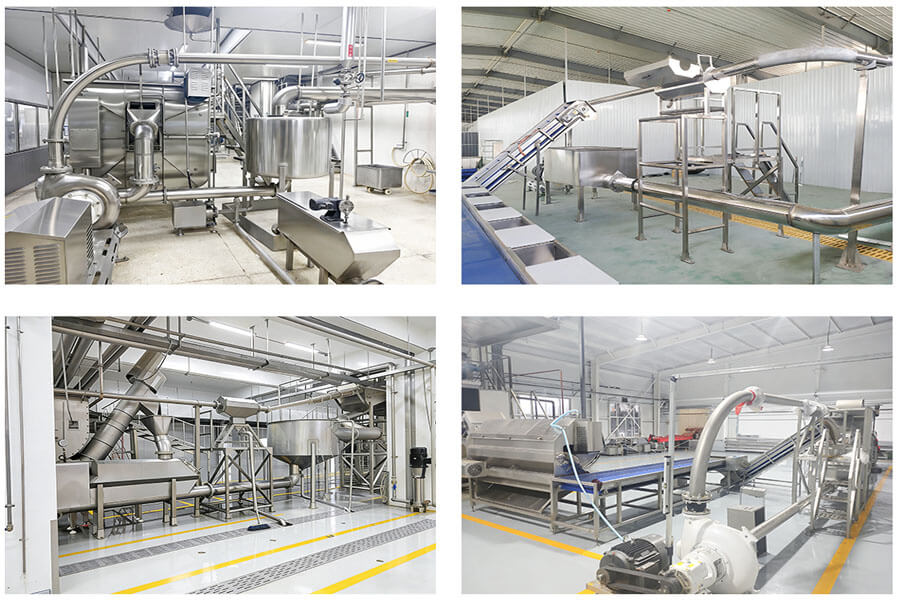
From Raw Potato to Golden Crisp: The Science Behind Industrial French Fries Production
In the commercial food processing landscape, the humble French fry is not just comfort food; it is a masterpiece of biochemical and mechanical engineering. Producing an industrial frozen French fry that achieves the globally desired gold standard—a glass-like, rigid exterior that stays crisp for 15+ minutes, coupled with a steaming, pillowy, baked-potato interior—requires far more than cutting and frying spuds.
Producing an exceptional commercial French fry is far more than processing a potato; it is about managing thermal transfers, starch retrogradation, enzyme kinetics, and fluid dynamics at every meter of the line. From continuous starch gelatinization to cryogenic crystallization, here is the step-by-step scientific journey of industrial French fry manufacturing and the engineering solutions driving modern processing lines.

1. Raw Material Selection: The Foundation of Fry Science
The industrial process does not start at the washer; it starts in the soil. A processor cannot correct fundamental raw material deficiencies down the line.
Dry Matter (Solids Content): The holy grail of processing is high solid content, ideally between 20% and 23% (specific gravity around 1.080 to 1.090). High dry matter ensures that water loss during frying creates an airy, porous internal matrix rather than a soggy, hollow core. Common cultivars include Russet Burbank, Innovator, and Shepody.
Reducing Sugars Management: Glucose and fructose levels must be kept strictly below 0.1% to 0.15% fresh weight. Higher concentrations react with free amino acids (primarily asparagine) during frying via the non-enzymatic Maillard reaction, resulting in unacceptable brown/black striping and elevated levels of acrylamide.
Conditioning: Stored potatoes must undergo controlled temperature conditioning (typically 8°C–10°C) to re-convert storage starches back from reducing sugars before they hit the processing floor.

2. Destoning, Washing, and Peeling: Minimizing Yield Loss
Once loaded via automated bulk hoppers, tubers begin their mechanical processing.
Destoning and Washing
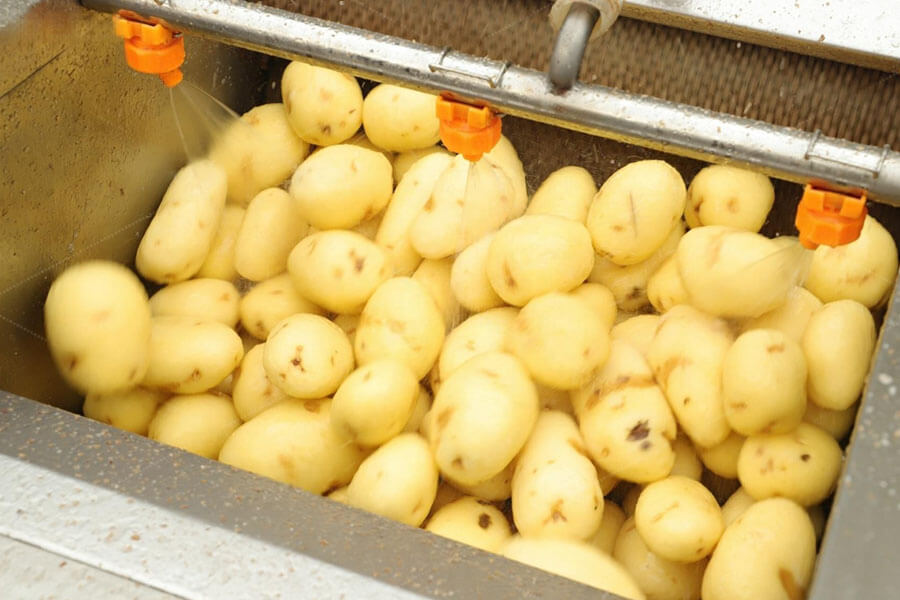
Tubers pass through a destoner (typically a vertical cyclone or heavy-particle flotation tank). Water density separation effortlessly drops stones, gravel, and heavy dirt, protecting downstream slicing blades. Drum washers then remove adhering clay and silt.
Steam Peeling vs. Abrasive Peeling
Most french fries processors use abrasive carborundum rollers; large-scale industrial lines exclusively employ High-Pressure Steam Peelers.

3. Precision Cutting: Potato Cutting Machines
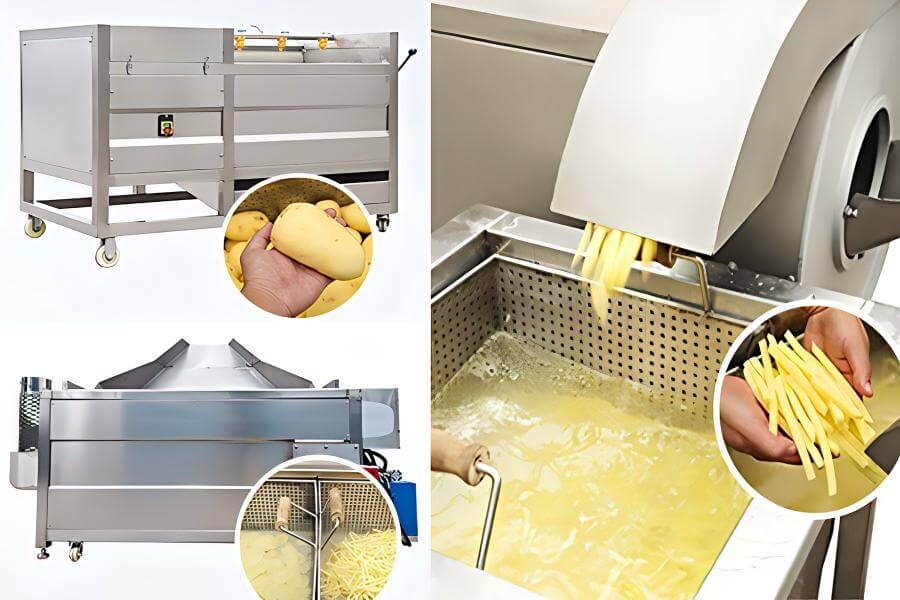
Mechanical French Fries Cutting Machines.
Engineered for Perfect Consistency, Maximum Yield, and Zero Bottlenecks. Our Industrial Potato Cutting Machines are engineered to solve the toughest bottlenecks in root vegetable processing. You can choose the cutting machine to make potato chips, sticks, flat slices, wavy slices, and cubes. The capacity ranges from 300 kg/h to 3,000 kg/h. These Mechanical French Fries Cutting Machines are the best choice for fast-casual restaurant chains, high-volume central commissaries, or massive continuous-fry potato chips plants. All the potato cutting machines are made of SUS304 stainless steel and equipped with Surgical-Grade Blades. We offer Global Voltage Customization. Precision, High-Yield Potato Processing Equipment for Every Potato Production Scale. We offer ultimate potato cutting solutions.
For High-Volume French Fries Production Lines: Choose the Centrifugal Potato Cutting Machines (QS-600 & HQS-3000). Ideal for continuous french fries lines requiring massive throughput.
For Large Continuous Potato Chips Lines: Choose the Industrial Centrifugal Potato Slicing Machines (QP-2000). Ideal for large continuous potato chips plants requiring massive throughput.
For Versatile Mid-Sized Processing (Slices & Sticks): Choose the Multi-Function Centrifugal Slicer/Sticker (QP-2000). Best for facilities that frequently switch between fries and flat potato slices.
For Perfect Artisan Potato Chips Lines(Crisps): Choose the Multi-Tube Directional Slicer (QP-600). Guarantees exact, uniform flat or oval slices with zero tearing.
For Banana/Plantain Chips Production Lines: Choose the Multi-Tube Directional Slicing Machine (QP-600). The angled feeding tubes allow operators to feed peeled bananas continuously, creating the perfect angled, classic oval slices or long banana slices that the global banana chip market demands.


The Hydro-Cutting System (Water Gun)
While mechanical rotary cutters suffice for lower throughputs, industrial lines (over 3 tons/hour) rely on Hydro-Cutters. Maximize yield, perfectly align cuts, and achieve extreme capacities 3000 to 15,000+ kg per hour with zero-impact fluid dynamics. Achieving pristine cut quality without bruising or surface tearing is vital for uniform oil uptake.
Potatoes are suspended in a high-velocity water loop driven by specialized food pumps.
They are propelled at speeds of 10 to 15 meters per second through a static grid of razor-sharp, tensioned stainless steel blades.
The Hydrodynamic Advantage: Fluid dynamics automatically align the elongated axis of the potato parallel to the tube, resulting in maximum length distribution (essential for premium QSR grades). The pristine, razor-sharp cut prevents the crushing of cellular walls, preventing excess oil absorption later.
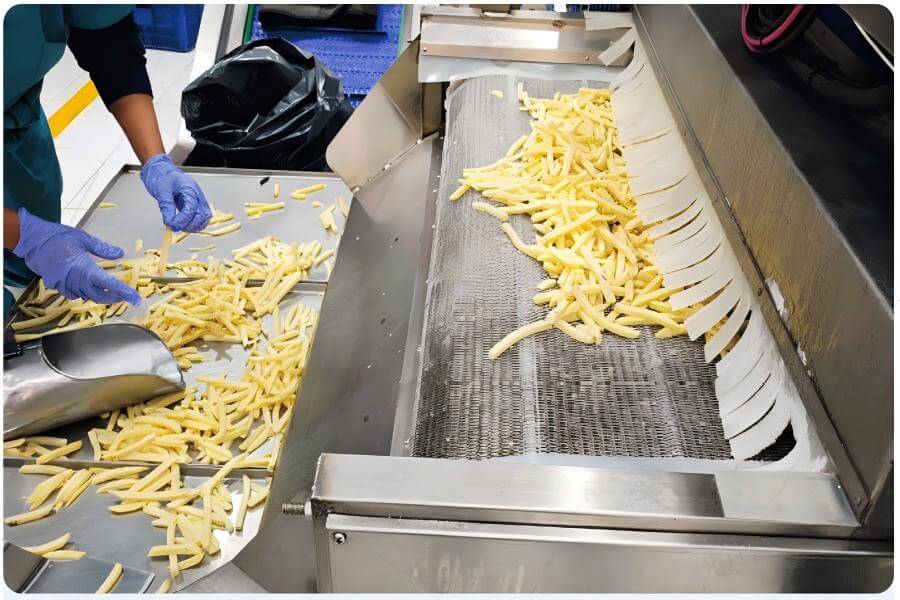
Real-Time Defect Sorting: Immediately post-cutting, optical sorting systems (using high-speed line-scan cameras and pneumatic rejection fingers) detect and kick out green spots, black hearts, or off-spec lengths at speeds up to 100 meters per minute.
4. The Potato Sticks Blanching Process: Enzyme Inactivation & Sugar Leaching
Blanching is the most scientifically critical step for controlling final color, oil uptake, and texture. Different blanching machines are used in different french fries lines. From entry-level artisanal batches to fully automated, high-capacity continuous production. Available in Manual, Auto-Discharge, and Continuous Conveyor configurations.

Water is the natural enemy of hot frying oil. Introducing wet strips into oil leads to oil spattering, rapid oil hydrolytic degradation (FFA increase), and excessive oil absorption by the fry.
- Vibratory Shakers & Air Knives: High-frequency shaker screens remove free surface water, while high-velocity ambient air knives sweep away surface droplets.
- Centrifugal Dewatering Machines: Advanced, labor-saving solutions designed for medium-scale french fries production lines.
- Target: A controlled reduction of 8% to 12% of overall strip weight.
- Surface Skin Formation: Drying forms a micro-thin, dense layer of semi-gelatinized starch on the cut surface. This layer acts as a barrier: during frying, it restricts steam from escaping too violently and, more importantly, prevents oil from entering.
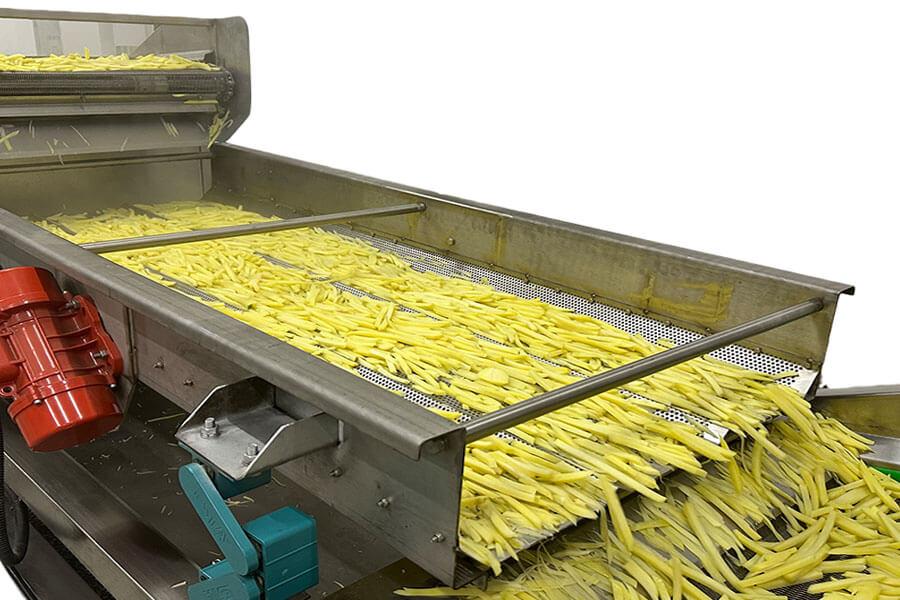

6. Par-Frying: Setting the Crust Architecture
Industrial frozen French fries are only half-cooked (par-fried) at the manufacturing plant; the final cook is done by the end consumer or restaurant operator.
- Process Dynamics: Strips drop into a continuous industrial fryer running pure vegetable oils (typically high-oleic sunflower, palm olein, or canola) at 175°C to 190°C (347°F to 374°F) for just 30 to 90 seconds.
- The Physical Transition:
Flash Vaporization: Surface moisture instantly turns to steam, creating an outward pressure that prevents oil from flooding the strip core.
Crust Solidification: Starch and protein matrices dehydrate and fry into a crisp, rigid structural shell.
Fat Absorption: Par-fry fat content is strictly governed to hit 4% to 6% (which will rise to 10%–14% during final restaurant reconstitution). - Industrial Fryer Engineering: Modern systems feature continuous oil filtration (down to <10 microns) and minimal oil hold-up volumes to ensure a complete oil turnover rate of under 6 hours.


7. Pre-Cooling and IQF Freezing: Safeguarding Cell Integrity
Moving directly from a 180°C fryer to a -30°C freezer would cause thermal shock, ice crusting, oil degradation, and massive refrigeration failure.
- Ambient and Forced-Air Pre-Cooling
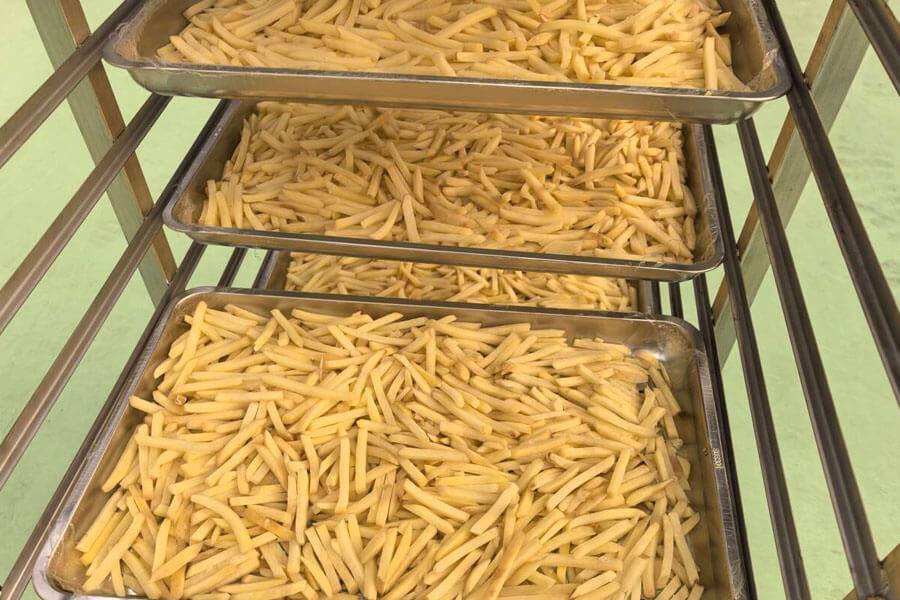
Strips travel down long, tiered cooling belts. Over 10–15 minutes, temperature naturally drops from ~140°C down to ambient (~30°C), followed by forced chilling down to 4°C – 8°C. This step hardens the outer crust before freezing and stabilizes interior steam condensation. - Individual Quick Freezing (IQF) Tunnel
The Fluidized Bed Concept: Strips are fed onto an oscillating, perforated stainless-steel belt. Cryogenic fans force high-velocity air at -35°C to -40°C upward through the belt.
Fluidization: The air lifts and suspends the fries individually, ensuring they freeze without sticking together into clusters.
Ice Crystal Control: Rapid freezing creates microscopic ice crystals within the potato cells. Slow freezing would create large, jagged ice crystals that puncture cell walls, resulting in cellular collapse (“mushiness” and water leakage) upon final thawing and cooking.
Target Core Temperature: Fries exit the IQF tunnel with a uniform core temperature of -18°C (0°F).

8. Multi-Head Weighing and Packaging: Protecting the Cold Chain
The frozen fries exit the tunnel onto clean, vibrating conveyors:
- Multi-Head Combination Weighing: High-speed multi-head weighers rapidly aggregate precise batch weights (e.g., 1.00 kg or 2.50 kg) with gram-level accuracy.
- Vertical Form Fill Seal (VFFS): Bags are purged with food-grade nitrogen (to prevent lipid oxidation and freezer burn), sealed, X-ray inspected for foreign matter, and auto-boxed into corrugated shipping cartons.
- Palletizing & Cold Chain Logistics: Cases are mechanically stacked on pallets and transferred into automated deep-freeze warehouses at a steady -20°C to -25°C.